

Interview with Eduardo López, researcher at the National Institute of Aerospace Technology and member of AIHRE
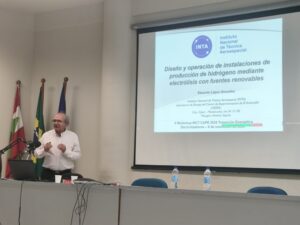
Eduardo López González holds a PhD in Industrial Engineering from the University of Seville and is a member of the National Institute of Aerospace Technology (INTA) since 1990, where has developed a wide research career in the field of hydrogen technologies and fuel cells. His work has focused on key aspects such as hydrogen storage, and the definition and validation of test procedures for proton exchange membrane fuel cells (PEMFCs), the production of hydrogen from renewable energy, safety in storage systems, and the evaluation of alternative fuels for more sustainable transport.
Over the course of his career, he has worked in numerous projects, both European and national, and has become recognised as one of the leading experts in the technological development of hydrogen in Spain and Europe.
- How does the experience accumulated by INTA through national and international projects contributes to the work you carry out at AIHRE?
INTA has extensive experience in the evaluation and demonstration of hydrogen technologies applied to different sectors, including both in mobile and stationary applications. In fact, at the INTA Energy Laboratory in Huelva, the first solar hydrogen production plant in Spain - and one of the first in Europe - was designed, built and evaluated. This plant has been progressively expanded and updated over time, incorporating new electrical and thermal energy storage systems in hybrid configurations, which allows for the optimisation of the management of the available renewable resources and the fulfiment of the end user’s energy needs - whether in the form of electrical or thermal energy for stationery applications, or hydrogen/electricity for mobility.
All this experience in the design, sizing, development, evaluation, and experimental validation of models is being applied across the various activities that form the AIHRE project, within the field of hydrogen production, storage and utilisation, in collaboration with the other project partners.
- After more than three decades working on hydrogen technologies and fuel cells, what key developments would you highlight in this field from the 1990’s until today?
Technological development in certain sectors has been significant. For example, the utilisation of fuel cells in automotive industry has experienced considerable advances in terms of size, weight, reliability, and more - not only at the stack level but also regarding the balance-of-plant components. This progress has opened up genuine opportunities for these technologies in applications such as submarines o unmanned vehicles. We have witnessed how solid polymer electrolyte membrane technology has been predominant in low- temperature applications, especially mobility, while solid oxide technology has taken precedence in high- temperature applications, such as stationery applications with combined electricity and heat generation, leaving behind other fuel cells technologies that were once considered promising.
Hydrogen production via electrolysis has also seen remarkable progress, particularly in the development of electrolysers with Proton Exchange Membrane (PEM) electrolyte. Anion Exchange Membrane (AEM) electrolyte technology is also commercially available, although its durability still needs significant improvement to compete effectively with other more established technologies, such as PEM or alkaline. In the case of alkaline electrolysers, although their development may have been less pronounced over the past few years compared to PEM technology, they will continue to play a key role in the expected expansion of large-scale hydrogen production plants, mainly due to its lower costs (at present) and technological maturity.
- What technical aspects (production, storage, safety, integration into energy systems) do you consider most critical today to consolidate the hydrogen economy?
Regarding the previous question, hydrogen production via electrolysis and its utilisastion in specific fuel cell technologies has reached a high level of technological maturity, enabling their commercialisation and large- scale application with appropriate guarantees across various fields, although aspects such as cost and durability still need improvement. In my opinion, the main bottleneck to address in order to consolidate these sectors and establish a true hydrogen economy is hydrogen storage, transport and distribution. In most applications, hydrogen production plants, particularly those powered by renewable energy, will not be located close to consumption centres, whether for mobility, energy generation or industrial applications. This means that we need to have safe, large-capacity hydrogen storage systems, at a low cost and with minimal losses - both at production and consumption sites. We also need to connect these facilities through the appropriate transport and distribution systems for pure hydrogen, or through carriers that allow efficient and economical formation and decomposition (or hydrogenation/dehydrogenation).
On a smaller scale, the development and evaluation of on-board hydrogen storage/generation systems for mobile applications remains a major challenge for the implementation of fuel cells in these applications, despite the advances made in existing commercial vehicles.
Additionally, another aspect to be improved would be the management of large hydrogen production facilities, including the possible combination of different electrolysis technologies and even hybridisation with other hydrogen production technologies such as biomass gasification.
- What opportunities does renewable hydrogen bring to the POCTEP region in terms of innovation and competitiveness?
At the European level, two areas are currently being considered where the cost of renewable hydrogen is expected to become competitive with hydrogen produced from fossil fuels - depending, of course, on other geopolitical factors. These areas are the Scandinavian Peninsula and the Iberian Peninsula. In the Iberian Peninsula, the POCTEP region comprises the majority of the areas offering the most favourable conditions for producing renewable hydrogen via electrolysis, without overlooking the existing potential for hydrogen generation from biomass. These factors mean that the POCTEP region could play a highly significant role in the production and supply of renewable hydrogen to end users located elsewhere in Spain or across Europe. In this context, the current projection of major infrastructures across the region for hydrogen transport - with interconnections with Portugal - makes it a particularly attractive location to build large-scale hydrogen production plants. This is further supported by the presence of important ports capable of handling and exporting part of this production, whether as hydrogen or other types of carries, to key consumption centres.
However, these potential advantages could turn the POCTEP region into an energy-exporting centre, without the availability of a competitively priced energy vector – complementary to electricity – necessarily leading to the transformation of the economic and industrial sectors within the region, particularly those where emission reductions are challenging to achieve though electrification alone. The AIHRE project aims to be part of this transformation, helping ensure that the POCTEP region also benefits from its enormous potential of renewable hydrogen production, as well as from the existing and planned infrastructures, and to generate local added value that positively impacts industry, administrations and end users. Identification of representative use cases, along with the analysis of how to adapt to available hydrogen technologies, will allow to demonstrate to key regional agents - in a realistic way - how this transition could be approached, what its costs would be, and which difficulties and barriers (technical, regulatory, legislative etc.) have been identified and need to be addressed.
Projects such as AIHRE generate knowledge and information to support companies and administrations in developing appropriate strategies and objectives for their decarbonisation processes, considering different scenarios and sensitivity analysis, offering them significant advantages in terms of innovation and competitiveness.
- What role can an institution such as INTA play in the transition towards a more sustainable energy model?
INTA is a Public Research Institution. Among its objectives are the generation of knowledge, the promotion of innovation, and the transfer of scientific and technological advances to socio-economic sectors and society at large. Particularly, El Arenosillo Energy Laboratory, in Huelva, has been collaborating for over 30 years with companies, administrations, universities and other research centres in the development and demonstration of technologies and services that contribute to the deployment of renewable energy, to an improved energy efficiency and rational energy use, and to the reduction of carbon emissions and other pollutants. At our laboratory, we primarily carry out applied research, always with a clear focus on real-world application and taking into account the end user’s needs. In this context, we work alongside with technology and service providers – whether companies, universities, or research centres – to improve and optimise their products, increasing their technological maturity level and preparing them for potential commercialisation, provided that there is a market demand for this type of product or service.
At our laboratory, we focus not only on hydrogen technologies, but also on meeting the needs of the end user with the best available technologies - at present and in the short term. We sometimes propose solutions that integrate different energy generation, storage and management technologies, such as hydrogen and battery systems. With our experimental facilities, prototypes and demonstration projects, we aim to provide real insights into both the advantages and the limitations of these technologies, enabling the potential users to make decisions and to incorporate them into their mobility strategies, emission reduction plans, efficiency and energy diversification plans, commercial and market policies, participation in future R&D projects, and more.
To achieve this, it is essential to collaborate with a broad network of partners, established over many years and through numerous projects, whose capabilities and experience complement those offered by INTA, in order to meet the requirements of the end users of these technologies and society at large.
- Finally, what are your personal thoughts on the potential of hydrogen as a driver of change in the energy transition and on the value of collaborative projects such as AIHRE?
Renewable hydrogen has significant potential in the energy transition process towards a low-carbon or zero- carbon economy. However, it is essential to recognise that hydrogen is not the solution to every challenge or application. It should be considered objectively as complementary vector to renewable electricity. Thus, there will be scenarios where the direct use of electricity will be the most appropriate option, others where the most suitable solution will be based on hydrogen technologies, and others where the optimal approach involves a combination of battery-based storage systems and hydrogen technologies, supported by appropriate management and control systems.
From my point of view, it is important not to create false expectations around renewable hydrogen, particularly in these early stages of market development, as this may later lead to doubts about its real viability. I believe that all experts and organisations with experience and a solid record in this sector have a key responsibility to communicate clearly to the agents involved – particularly industries and administrations – which sectors and applications can benefit from the use of renewable hydrogen, and to what extent, as well as the conditions that must be met for this potential to translate into real and positive impact on those sectors. This includes striving to moderate and bring rigour to political messages, which at times suffer from unjustified optimism, oversimplification, or a lack of understanding of the sector, and can contribute to those false or exaggerated expectations already mentioned.
As previously mentioned, hydrogen has its niche – and a very important one. The key lies in clearly defining that niche and identifying how to make the most of the business opportunities it offers. In this regard, collaborative projects such as AIHRE, with a highly interdisciplinary approach but a strong focus on end-use applications and business models, provide highly relevant results and insights. These are crucial for showcasing the potential benefits of renewable hydrogen in the region, as well as for identifying the barriers that may hinder its development. The methodology employed in the project combines preliminary sizing tools for hydrogen facilities; modelling and simulation tools for demonstration plants; testing and trials in experimental facilities for hydrogen production, storage, and utilisation technologies; and technical, economic and environmental analysis of different use cases – using tools and methods that are also applicable to other potentially relevant scenarios in the POCTEP region, among others. Achieving these results requires collaboration among a range of entities with strong expertise and experience in the sector – as is the case with the partners involved in the project. Only through cooperation and coordination among partners can the project be successful, ensuring that its achievements go beyond documents and meetings, and instead deliver real, lasting impact on businesses, administrations, and other organisations that can benefit from these outcomes.


 EN
EN  ES_ES
ES_ES  PT
PT