

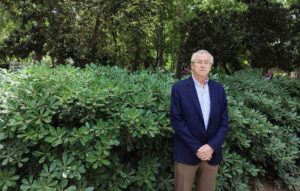
Interview with Miguel Ángel Ridao Carlini, professor at the University of Seville and member of AIHRE
Miguel Ángel Ridao Carlini is a leading figure in the field of engineering and energy research in Spain. A professor at the University of Seville in the Department of Systems Engineering and Automation, his professional career is a benchmark in the modelling, control and optimisation of complex processes.
In his dual role as a researcher and lecturer, Ridao brings a unique perspective to the AIHRE project. Not only does it work on the algorithms that will make renewable hydrogen a technical and economic reality, but it also trains the professionals who will lead the transition to a decarbonised economy in the cross-border region between Spain and Portugal.
- You are working on the development of ‘digital twins’ for PEM electrolysers. How does this technology help make hydrogen production more efficient and competitive within the AIHRE ecosystem?
Digital twins are a tool of great interest in our work at AIHRE, where we design control strategies and operating modes for energy systems geared towards the production of green hydrogen. Essentially, what we do is build a dynamic model that accurately replicates the behaviour of the electrolyser, enabling us to anticipate how the system will respond to different scenarios. Furthermore, this digital twin is continuously connected to the real system, providing a valuable data stream for applying advanced control methods and techniques based on artificial intelligence.
This is particularly relevant in the context of green hydrogen, where production is heavily influenced by the variability of renewable energy sources. With the help of the digital twin, we can adapt the operation of the electrolyser in real time to make better use of the available energy, operate at peak efficiency and, at the same time, avoid conditions that accelerate the system’s degradation.
From a strategic perspective within AIHRE, this has a direct impact on the competitiveness of hydrogen. On the one hand, we reduce operating costs by optimising energy consumption, which is one of the main costs of the process. On the other hand, we extend the service life of the equipment and reduce unplanned downtime, thereby improving the return on investment.
In short, the digital twin is not merely a modelling tool; it enables smarter, more optimised operation of electrolysers within complex energy systems, making hydrogen production more flexible, efficient and, above all, more competitive.
- What is the biggest technical challenge in ensuring that hydrogen production is perfectly aligned with the variability of renewable energy sources in the POCTEP region?
The biggest technical challenge is to manage this variability efficiently without compromising the performance or service life of the electrolysers. In the POCTEP region, where solar and wind power account for a very high proportion of the energy mix, we are faced with highly dynamic generation profiles, characterised by intermittency and, in many cases, a degree of uncertainty in forecasting.
The problem is that, although PEM electrolysers are more flexible than other technologies, they are not designed to operate in a completely arbitrary manner. There are physical, dynamic and degradation-related limitations that mean not every operating profile is desirable. The challenge therefore lies in striking a balance between utilising the availability of renewable energy and maintaining efficient and safe operation of the system. This problem is exacerbated when considering other technologies, such as alkaline electrolysers, which are more suited to production under steady-state conditions.
This is where digital twins and control strategies come into play, particularly those based on predictive control, an area in which our group has been working for many years. We need to anticipate the behaviour of both the renewable generation and the electrolyser itself, in order to decide at any given moment how to operate: when to produce more, when to reduce load, or even when not to operate if it is not efficient to do so.
From a broader perspective, it is also a matter of coordination at the level of the energy system. It is not just about the electrolyser, but about how it interacts with storage, the electricity grid and demand. In this regard, the technical challenge lies in developing tools that enable this integrated management in real time, whilst accounting for uncertainty and across different time scales. Ultimately, the aim is to achieve a truly flexible and optimised operation that makes the integration of renewables and hydrogen viable.
- As an expert in model predictive control (MPC) applied to microgrids, what role do you think hydrogen will play as a strategic storage system in the electricity grids of the near future?
Hydrogen has a key role to play as a strategic storage solution, particularly in the medium to long term, when other technologies such as batteries become less efficient. In systems with a high proportion of renewable energy, this is essential because it allows the timing of energy production to be decoupled from the timing of its use.
From the perspective of microgrids, this adds complexity because hydrogen is not an immediate storage solution like a battery: it has slower dynamics, lower full-cycle efficiencies and operational limitations. For this reason, how its use is planned and coordinated within the system is very important.
This is where predictive control is particularly important. MPC enables the coordinated management of renewable generation, electricity storage and hydrogen systems, by anticipating changes in demand and production. This allows for optimal decision-making in real time and enables the system to be operated more efficiently.
Ultimately, hydrogen will not replace other storage technologies, but will complement them, bringing flexibility and resilience to the electricity system, which will require it to be managed intelligently.
- From your perspective as a researcher, which results or technical advances from the AIHRE project have you found most promising to date?
In my view, one of the most promising developments is the ability we are developing to seamlessly integrate advanced modelling, real-world data and control strategies into hydrogen production systems.
Another key aspect is how we are managing operations in scenarios characterised by high variability in renewable energy supply. Promising results are being achieved in the design of control strategies that enable hydrogen production to be adapted flexibly, whilst maintaining efficiency and reducing degradation – which is one of the major challenges.
And perhaps on a broader scale, I find the integration approach particularly promising. We are not treating hydrogen as an isolated element, but as part of a wider energy system, which allows us to explore more robust solutions with a greater real-world impact.
All in all, I believe that AIHRE’s value lies precisely in that combination: making technical progress, whilst ensuring that these solutions are transferable and relevant from an industrial perspective.
- As a professor, how do your engineering students view the rise of hydrogen technologies? Do you feel there is a growing interest in specialising in this ‘green’ sector?
In my case, my teaching focuses more on the fundamentals of control and automation, so hydrogen does not feature explicitly in the course content. We do address it more directly in certain specific modules, such as those on the control of hybrid or hydrogen-powered vehicles, but where interest really becomes apparent is in the final stages, particularly in undergraduate and master’s dissertations.
Many students are interested in topics related to microgrids, the integration of renewable energy sources and, within that context, the role of hydrogen as an energy carrier. They do not always arrive with a specific interest in hydrogen, but once they are exposed to these issues, their interest grows quite naturally.
I would say that what is growing is the interest in training in tools that are key to this field, such as advanced control, optimisation and the analysis of complex energy systems. And that is very positive, because ultimately the sector needs professionals capable of integrating different technologies.
In that sense, there is indeed a growing interest in ‘green’ issues, but this is channelled more through specific problems and applications.
- Are Spanish and Portuguese universities equipping engineers with the specific skills (automation, chemical process control, safety) required by the new hydrogen economy?
I believe we are moving in the right direction, but there is still room for improvement. Engineering schools in Spain – and I understand the situation is similar in Portugal – have a very solid foundation in key areas such as automation, control and, to a lesser extent, industrial processes, which are fundamental to the development of hydrogen.
The problem is that the hydrogen industry is, by its very nature, highly interdisciplinary. It combines aspects of electrical engineering, chemical engineering, control engineering and energy, as well as issues relating to safety and large-scale operation. And this kind of integration is not always fully reflected in the curricula, which remain largely structured by discipline. It would be important to promote a more practical and integrated approach, where students can see how these technologies are integrated in real and complex applications. It is true that, at least at our engineering school in Seville, significant steps have been taken in this direction.
In short, the educational foundation is sound, but further progress is needed to adapt it to a more integrated, practical context that is aligned with real-world needs.
- In what way do you think collaboration between universities and businesses on projects such as AIHRE directly benefits the students who will one day be leading these power stations?
Collaboration between universities and industry is essential because it helps bridge the gap between what is taught and what is actually required in practice. Thanks to the projects we are involved in, such as AIHRE, students do not merely work with models or theoretical concepts; instead, they engage – albeit indirectly – with real-world operational challenges, real data and the constraints typical of industrial environments, which significantly transforms the way they learn.
Furthermore, this type of collaboration enables them to see where the sector is heading. They identify which technologies are being implemented, which are emerging, which skills are in highest demand, and how different disciplines are integrated into real-world applications, such as in the case of hydrogen.
These projects enable students to undertake more practical undergraduate or master’s dissertations, and even facilitate a smoother transition into the workplace, as employers value students who have already worked – even if only in an academic setting – on problems that closely mirror real-world scenarios.
- Looking ahead to the coming years, how do you envisage the energy landscape of our region evolving as a result of the foundations being laid today by the AIHRE ecosystem?
Looking ahead to the coming years, I believe we will see a much more integrated and flexible energy system, which will require intelligent energy management. In a region such as POCTEP, with significant renewable energy potential, hydrogen will establish itself as a key element in harnessing that energy, particularly at times when it cannot be fed directly into the grid.
Rather than a radical overnight transformation, what we will see is a gradual shift towards systems in which renewable generation, storage and consumption are much more closely coordinated. In this context, hydrogen will not be a stand-alone technology, but rather another component within a broader energy system.
I believe that the value of initiatives such as AIHRE lies precisely in accelerating that transition, not only from a technological perspective, but also in terms of knowledge, talent development and the creation of solutions that can actually be implemented.
If that ‘seed’ takes root, what we will see is a more robust system, less reliant on external sources and better equipped to manage the variability of renewables. And here, once again, tools such as advanced control, optimisation and digital twins will play a key role in ensuring that the whole system operates efficiently.



 EN
EN  ES_ES
ES_ES  PT
PT